Exploring the Social Imagination

Tuesday, November 1, 2022

Social Constructs in the Social Imagination...


For years, I have been discussing on this platform the social imagination as the construct for social reality. Largely, that construct (created in the social imagination ) is built on agreement and even through disagreement; because, in that, we agree to disagree... hence, agreement. I always like to find other thinkers/authors who agree with me and here are a couple.

1-    Social realities are all around us. Think of cocktail parties, football games, bar mitzvahs, political rallies, and even nations.  These are all social realities. And in connection with this sort of thing both parts of that phrase “social reality” are worth focusing on. All the things I just mentioned are things that really and truly exist.  

    They aren’t figments of anyone’s imagination; they’re real.  Really real.  Objectively real.   But at the same time, they're all made up entities, at least in a sense. Cocktail parties exist only because a group of people get together and say “we're having a party now.”  People just sort of decide that these things are going to exist.  And so they do exist.  Seems kind of like magic.

    It isn’t really magic, but it is puzzling.  At bottom, social realities are just creations of the human mind.  Not individual human minds, but collections of human minds.   You can’t all by your little lonesome create a social reality.  Try it and you really will end up with something that’s just a figment of your own imagination.  But put a bunch of people together, let them exercise their imaginations together; let them agree; and presto, you’ve got a new social reality. 

    What could, I suppose, make that sound a little like magic still is the fact that it takes at least two minds to make a social reality. If one mind can’t do it, why are two or more minds any better, you might ask.  Well the answer is that social realities are, by their very natures, founded on agreement.   If a bunch of humans agree to create a club, then there is a club.  

    If a bunch of humans agree to form a nation, then there exists a nation.  And although clubs and nations are nothing but products of human agreement, they're not figments of our imagination.  To be sure they are products of our imaginations, but they’re real products, not mere figments.  Once we agree that they exist, they are as objectively real as rocks and mountains.

    Not only are things like clubs and nations real, they are  really important.  They have a huge impact on our lives.   We’re immersed in a universe of ever changing social realities.  And they play an immense role both in determining how we live and how well we live.   Our earliest forbears foraged on the savannah and huddled in caves. 

    Civilizations have risen and fallen and with them, ways of life have come and gone.  Throughout these massive changes in the social world, the biological and physical worlds have changed too -- but not as radically, and mostly in ways that are more or less direct consequences of changes in the human social world. 

    So the social world affects not only the way humans relate to one another, but also how we interact with the rest of the biological and physical world.   Science, for example, is really a complex social undertaking by which humans collectively seek to understand the physical, biological, and even the social world itself... [https://www.philosophytalk.org/blog/social-reality].

_______________________________________________________________

2-    Just as socialization is mostly determined by the world and culture around us, our perception of the world is also influenced by external forces. Consider your own society, for example. A society describes a group of people who live in a defined geographical area, interact with one another, and share a common culture. 

    How do you think your society was "constructed"? Who decided upon the appropriate social norms and behaviors that shape your reality and experience? Sociologists understand that reality is socially constructed, meaning that people shape their experiences through social interaction.

    In 1966 sociologists Peter Berger and Thomas Luckmann wrote a book called The Social Construction of Reality. In it, they argued that society is created by humans and human interaction, which they call habitualization. 

    Habitualization describes how “any action that is repeated frequently becomes cast into a pattern, which can then be … performed again in the future in the same manner and with the same economical effort” (Berger and Luckmann 1966). Not only do we construct our own society but we also accept it as it is because others have created it before us. Society is, in fact, a matter of “habit.”...[https://www.coursehero.com/study-guides/wmopen-introtosociology/reality-as-a-social-construct/].


Commentary ~ I agree! Sadly, the rest of the world, especially those who have power, control and the money, including universities, will never admit that above truth about social reality. Why? They don't want to lose their grip on the wider social imagination and the social reality at hand because if they do... it and they with all they control in it will disintegrate. 

You might be wondering why the Salvador Dali painting as my choice of photo (see above). It represents what I just explained. When those who have power, control and the money to retain that power lose their grip on the social imagination, and they lose their grip on social reality and their power/control and money... 

The clocks are representative of time. You see time is only 'real' because it is necessary in the social imagination as a means of ordering the social reality. The social imagination 'agreement reality' needs time. It needs time for agreement and once agreement is established, it sets a course (what appears as a way forward) for the agreed upon person/thing/place/event to become real in the social imagination's social reality construct. The more who agree the stronger the construct... at least while it lasts.

Now, how long the agreement (including disagreement) lasts is determined by and determines everything else in the social imagination's construct of social reality.

Keep in mind, in the social imagination, a vicious cycle exists, a strange loop which perpetuates those things which we keep agreeing on and disagreeing on ...because, its a fallen world, a world in a state of decay and which at some point... we should all want to see come to an end. It may look like things have changed, but in the social imagination's social reality they don't and won't or simply can't... Its a fallen world folks! 


....until the Creator Returns!


Friday, October 21, 2022

Change the World Mentality in the Social Imagination...

    This quote from Orwell really does seem to sum up how we feel about the generations before and after us. Though differences between generations may seem like caverns, they really are not. Sure, we think we see different ‘Generations’ but that's only from a marketing perspective... labels such as: Generation X: 1961–1981, Gen Y (Millenials): 1982–1995, Gen Z: 1996–2002 and the all-new Generation Alpha from 2003. [https://medium.com/bwp-group/every-generation-imagines-itself-to-be-more-intelligent-than-the-one-that-went-before-it-and-wiser-7861d584e518]. 

    So, what's really happening? Aren't we evolving? Aren't we moving forward in time and space? After all, look at technological developments.  Well, there really isn't anything new under the sun ~ Ecclesiastes.... including technology. Sure, it looks different, sounds different, and works different. But, the idea of a new thing is not really true and it it were somehow really true it would only be temporary in our social imagination until the next new thing comes along. But, again... it never really was new. 

    You see, the social imagination (every generation of it) likes to imagine something is new. But, it is just reconstructed to look, sound, taste and feel different or at least enough to make us think it is different or new. What about going to the moon you say, "no one ever did that before Gen. X". Well, there have always been 'new' horizons in man's social imagination... in fact. through all time, the moon was just one of them.  

    And, what about making more people healthier, happier, democratic...  aren't those things new and hasn't technology made those things more possible for more people everywhere? I suppose relatively it seems like it. But, from a bird's eye view, men have been healthy, happy and democratic in the long past. 

    Sure, maybe more people appear to have those things because there are more people in terms of population; but realistically, as ratios, in terms of having those things, it only appears that those things have increased... but have they? What has really changed?

    Whenever someone says they are going to change the world they only intend to change it from their point of view, not their neighbors.  All sorts of people throughout time have had experiences with those things just mentioned and technology of different kinds...given that one should expect that the world would be changed by now. But, its not; and, if it has been changed... how exactly? 

     There do seem to be a few threshold events that appear to have radically changed the world. I would suppose CV one niner will be remembered as one as well as all world wars and civil wars, stock market crashes, assassinations, invasions and not excluding natural disasters such as earthquakes, volcanic eruptions, hurricanes etc. 

    The key is word here is 'appear'. Whether its perceived as radical or not. A lot of what happens to us is perception. To find out why, we will borrow from some Wikipedia writer... We can point to the special theory of relativity for instance to find out why. It is impossible to say in an absolute sense that two distinct events occur at the same time if those events are separated in space.

    For example, a car crash in London and another in New York appearing to happen at the same time to an observer on Earth, will appear to have occurred at slightly different times to an observer on an airplane flying between London and New York. 

    Furthermore, if the two events cannot be causally connected, depending on the state of motion, the crash in London may appear to occur first in a given frame, and the New York crash may appear to occur first in another. And, you see here... appear in an order of things. No one can say what happened or what changed first.

    Appearances are important and more important to the the social imagination because it is agreement reality. So, we do need things as events to 'appear' to us (be revealed or show up on the scene) and we need them to appear as different or new or even the same. 

    But, do we really need change? What we do need more than change is to agree as much we need to agree to disagree to make life appear real to us. With agreement and even with disagreement comes a residue of imagined changed. 

    Its not that anything really changed but we imagine it did because we either agreed on something or we disagreed. Every generation thinks that they are the first to breathe air, the first to talk, the first to think or imagine something. And every generation needs to agree on something and disagree.

    Just because we agree or agree to disagree doesn't make change or add new meaning and it certainly doesn't make a brand new world. Americans are probably the most guilty of this 'change the world' generational curse because they like to think and agree with each other and especially agree that they are a 'newly imagined' country with new ideas never before conceived or lived. 

    Most immigrants who come here think that too ... whether they come legally or not. As for being a new idea... well, I hate to tell you but the Greeks and Romans thought that too. 

    You can't change the world but you can change how you look at it and what you  agree/align with... but it still does create anything new nor even meaning nor does it create a brand new world and it never will... until the day of the Lord.


Wednesday, October 5, 2022

Building on Sinking Sand ... in the Social Imagination


    Silicon Valley is home to a plethora of wealthy tech companies, but the sinking land beneath risks leading to far worse floods in the years to come, researchers said Wednesday. 

    This sinking, or subsidence, coupled with sea level rise, doubles the territory in the area known as Silicon Valley at risk of flooding by 2100, said the report in the journal Science Advances. 

    Until now, official government flood maps and projections have been based solely on estimates of sea level rise. "The ground goes down, sea level comes up, and flood waters go much farther inland than either change would produce by itself," said lead author Manoochehr Shirzaei, assistant professor in Arizona State University's School of Earth and Space Exploration. 

    Most of the San Francisco Bay shoreline is sinking by less than two millimeters a year, but "in several areas we discovered subsidence rates of 10 millimeters (half an inch) a year and more," said the study.


*This short article above was published in thejakartapost.com with the title "Land beneath Silicon Valley is sinking fast: Study". ~ https://www.thejakartapost.com/life/2018/03/08/land-beneath-silicon-valley-is-sinking-fast-study.html.


Ok, we found out why Silicon Valley is sinking but why is Silicon Valley called 'Silicon Valley'? Its not because its sinking but maybe it is called that because it is sinking. Largely, its because of the industry that has built up there in the San Fransisco Bay area... technology using silica sand. Not only here in the US, but all over the world man is building his future on silica sand... Hence, Silicon Valley.

 Let's look at another article ~

     Silicon wafers are fundamental in manufacturing the electronic “chips” that pervade almost every aspect of our lives. New applications in IoT, wearable and mobile devices, self-driving cars, cloud computing, 5G communication networks, and more, practically guarantee that demand for wafers will continue to grow at an accelerating rate. 

    Our life is now built on the SEMI... the semiconductor equipment manufacturers’ industry association. Recently, that industry announced that 2018 shipments of silicon wafers had set a new record of more than 12 billion square inches, up 8% from the previous year. Revenues for the year totaled $11.38 billion, up 31% from the previous year and exceeding $10 billion for the first time ever. 

    But wafers are not the only place silicon is used and they are not even close to the largest consumer of silicon. Construction (sand and concrete) followed by steel and aluminum are by far the largest. There are smaller applications for silicon that are also critical, such as solar energy and specialty parts for semiconductor manufacturing equipment.


Sand to wafers…
    Fortunately, there is no shortage of raw material. Silicon is the second most common element in the earth’s crust, comprising about 26% and exceeded only by oxygen at 49%. But silicon does not occur naturally in the pure form needed for electronic applications, for which it must contain less than one in a billion non-silicon atoms. The starting material really is sand. Not just any sand, but silica sand, specially quarried for this purpose and having concentrations of quartz (silicon dioxide) as high as 95%.

Online Source * ~ https://semiengineering.com/from-sand-to-wafers/


Commentary: "The rain fell, the torrents raged, and the winds blew and beat against that house; yet it did not fall, because its foundation was on the rock. But everyone who hears these words of Mine and does not act on them is like a foolish man who built his house on sand. The rain fell, the torrents raged, and the winds blew and beat against that house, and it fell—and great was its collapse!”…~ Matthew 7:25-27. 

Folks, the Social Imagination will ultimately be controlled if not already by technology and such a house will collapse.  


Monday, September 19, 2022

Technology Breaking Down the Social Imagination...


Yes, you read that right... technology makes us lazy, it makes us expect less from each other. We expect less from mother, from father, from grandparents, from neighbors, the community and so on... We don't expect women to be women (mothers/wives included) and we don't expect men to be men (fathers/husbands included)...we just don't expect much these days from people.  

We don't expect much from our family, our neighbors, our children our municipal workers, our representatives etc... after all, they are giving it their best. But what is that anymore? 

Because of that, we don't dress to impress, we don't live to aspire or inspire, we don't work to achieve, we don't learn more than we have to, and we for sure don't do anything that causes us too much time, effort, pain, stress, or demands anything more than taping a screen.

Don't believe me? Look around folks! Go to Walmart and take a gander. Read the newspapers, watch television, see a movie, or have dinner out... the writing is on the wall!Men used to dress to impress, wear a suit and hat to work. Women used to dress up for a date... to impress. 

Now, they all dress down... no one needs to impress anyone because no one is inspired to do so... Sure, other things can feed into the dumbing down of America, but technology as lowered our expectations. Numerous historical events mark this out... So, anyone can observe how technology has caused people to become dumb slobs. Hence, we recruit workers from other countries who can still think for themselves. 

You can blame corporate America who made the technology, or the universities who did the research and produced the experts. But its the technology itself in the hands of the masses that has become a trip- to-fan (tryptophan) event... We have taken a trip that has no destiny... we sleep most of the way peeking to see if any notifications have popped up. 

Think I am mistaken... think again as you read this:  Is Smart Technology Making Us Dumb? Yes and no: there are reasonable arguments on both sides of the question : Article By  on 

 I believe we may be making ourselves dumber when we outsource thinking and rely on supposedly smart tech to micromanage our daily lives for the sake of cheap convenience.

    The internet provides us with seemingly limitless data, prose, images, video and other raw materials that could in theory enhance our intelligence and enable us to become more knowledgeable, to be more

    skillful or to otherwise use actionable intelligence. Maybe we could improve our decision-making, reflect on our beliefs, interrogate our own biases, and so on. 

    But do we? Who does? Who exactly is made smarter? And how? And with respect to what? Are you and I, and our siblings and children, engaging with the seemingly limitless raw materials in a manner that makes us more capable, more intelligent? Or do we find ourselves outsourcing more and more? Do we find ourselves mindlessly following scripts written or designed by others?

    We’re easily led to believe that we’re extending our minds and becoming more intelligent with a little help from the digital tech tools, when in reality, those are often just illusions, sales pitches optimized to pave the path of least resistance. Every time someone suggests they’ve extended their mind with their smartphone, that they are thinking through and with their phones, I respond by asking them about who’s doing what thinking.

    Are they extending their mind or extending the reach of others into their mind? When you rely on GPS, who’s doing the route planning? Who is really gaining what intelligence? Are you smarter...because of GPS?

    What impact does outsourcing navigation and awareness of your surroundings have on your capabilities? Certainly, Waze or Google gain intelligence about you, your surroundings and even others around you. That could be good or bad, but it’s not really extending your mind or expanding your intelligence. 

My comment to this author's observation is that its true... oh so true! Even more because of the radical drop in the level of expectation between people; and, its made less and less daily. This ever so important aspect 'expectation' in the social imagination is what primes us to become thinkers, and gets us to stand on our own two feet and its disappearing at an alarming rate. 

So, we will continue to expect less and less from each other here at home and on a global level... other than the latest phone  and service upgrade... Well, then what do you or could you expect? NOTHING !!!


Onlinie Source ~ https://blogs.scientificamerican.com/observations/is-smart-technology-making-us-dumb/


Saturday, September 3, 2022

The Threats to Democracy in the American Social Imagination...


In 1984, John Brigham wrote a book called, "Civil Liberties and American Democracy." In chapter 7, Brigham writes about threats to American democracy. He states that threats to democracy in America appear to be from three sectors: the elites, the people and the experts. It is so worthwhile to read that instead of completely summarizing, short excerpts will be used.

The first threat comes from the top - elites. Who are they? They are the power elite as C.Wright Mills wrote in 1956. They are people who occupy the higher tiers of society because they have either money or power or prestige or they have all three.  Brigham points to them first as they are truly the ones who hold the balance of economic and military power. Among themselves they compete for more money, power and prestige which effect everyone else.

There is no open competition in this scenario (names and places at the top may change but the game remains) and because of that there is an ever constant threat to democracy as they feel that their established order is under threat. Thus, Brigham asserts that we should always be alert to the usurpation of state power, whether it is by unaccountable private interest or under the justification of military emergency.

The second threat comes from the people. Really? Yes, really. Largely because, there is no truth in the masses as Kierkegaard noted. Such a threat comes from those who have no share in the top and what goes on up there. They lack information from the top and form groups of like mindedness because of that. Hence, there is no truth in the masses... for they are a mixed batch these days.

This kind of threat from the bottom should be taken seriously. It is out of alienation from the top, a feeling of hopeless and helplessness. This feeling creates the illusion (real or not) that there is something bigger and menacing that is out to get the little guy, something that wants to take his job, his family, his faith and his life; and unless he/she goes along to get along he/she is doomed.

The third threat comes from experts. Who are they? In America, Brigham firstly points out lawyers and even judges mostly influenced by elites and politicians and or including other kinds of experts: university administrators, think tank groups, foundation/association/org lobbyists, and even today- journalists that are paid to pull strings for the all the others just named.  Experts can be 'made people'; made by the elites who want to keep their status and or position of power and thus control the people with their so called 'expertise'.

Today, we can observe these three threats underway, undermining American democracy. And, a kind of internal shaking is being felt nationwide and worldwide. Is America a democracy for the people and by the people? It should never be doubted lest America decays and disappears into the history pages. That rhetoric is being used but with a new twist. The experts and elites who control politicians and lets include the military industrial who is in bed with all three. They are revising the United States of America. They are changing who/what (USA) America is, who the people really are. They use political rhetoric (fighting words) to reshape what life, liberty and the pursuit of happiness means... what it means to them.

I think we can safely say... that's what is before us in the theater of the social imagination.


Friday, September 2, 2022

A Techno-Military Takeover in the Social Imagination...

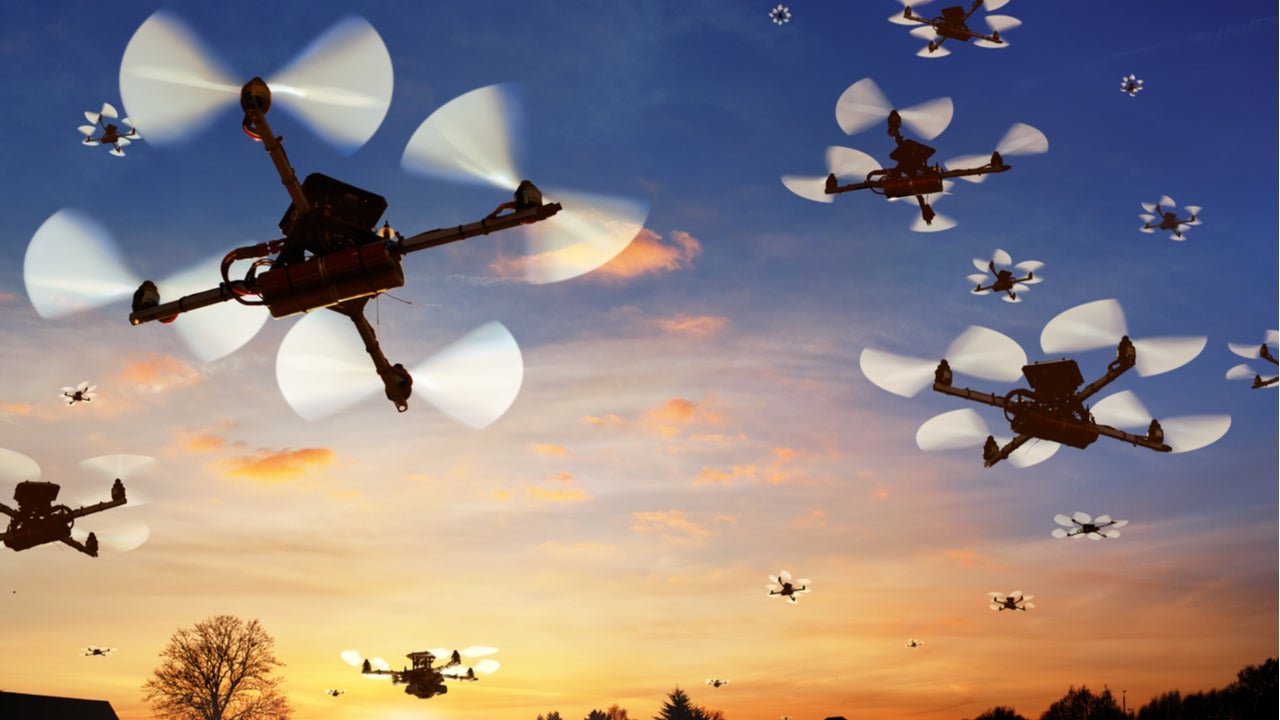
 Initial operating capability for swarm drone technology could be achieved  in less than ten years: Poll

Its enough to remember both world wars to get a stark glimpse of what everyday life was like when there was...a military takeover. Did machine technology have a major role then? Yes. And, isn't' it very interesting that media today produces scenarios with plots mimicking exactly that but with newer machines. You may or may not have seen the USA Network series, "Colony" (2016-18). 

As a 'show' it was meant to entertain of course but perhaps to warn; after all, it had an eerie historical element (Nazi occupation of France i.e.). The series was cancelled when it seemed to be riding high in viewership. In fact, it has had petitions since created to bring it back but sadly to no avail. Why? Maybe it was too close to a planned coming scenario to be implemented in your everyday life.

Let's look at the plot for Colony. 

In a dystopian near-future Los Angeles, residents live under a regime of military occupation by an organization known as the Transitional Authority. The Authority serves an extraterrestrial group referred to as the "Hosts", about whom little is known until later in the series (an alien robotic race finds itself hunted, who came to Earth to use humans as allies and labor in their own battle). 

The symbol of the collaborating forces features stylized birds of prey, or raptors, which gives rise to their nickname, the "Raps". The Authority enforces Host policy via militarized police called Homeland Security and nicknamed the "Redhats" for the red helmet cover of their otherwise black tactical attire.

The Hosts took control on a day known simply as the "Arrival". That day began with massive worldwide communication interference and jamming, which came after a weeklong hunt for relevant key figures around the world. Late that day, massive rectangular blocks descended from the sky, linking together to build walls dividing the city. One of these walls, 20 to 30 stories tall, many meters thick and many miles in length, surrounds the central part of Los Angeles, where the series is set. 

Other similar walls have been constructed around neighboring urban areas, called "blocs", with the whole referred to as a "colony". Traffic passes through the walls at heavily secured checkpoints, called "gateways", which allow the Authority to strictly control the movement of people and the distribution of consumables, such as food and fuel, which are rationed. The geographical extent of the alien invasion is unclear, but later scenes in the series shows Authority members from all over the world - hence making the invasion scale worldwide.

A privileged class of elites, drawn by the Hosts from the local population, are denigrated by some bloc residents as collaborators. The ruling forces maintain control through the separation of family members, shoot-on-sight curfews, forced disappearances, random checkpoints, frequent electronic identity checks, limitation of motor vehicle usage (most people walk or ride bicycles), pervasive visual propaganda, slave labor in a place called the "Factory" (later revealed to be located on the Earth's moon to mine radioactive materials), and massive continuous electronic surveillance with both hidden cameras as well as host-provided drone aircraft that launch from hangar bays inside the wall and capable of killing humans by extremely lethal high energy weaponry. 

Some medical problems, such as diabetes, have been "deemed unworthy for treatment" by the Hosts, to cull the population. A resistance movement is referred to as both the "Resistance" and the "Insurgency". An informal barter-based black market has also sprung up, trading in surplus materials and home-produced goods.

In a May 21, 2015, interview with Collider, executive producer Carlton Cuse stated that the show was "conceived as a metaphor for France during the Nazi occupation".   

In a separate interview with Entertainment Weekly, co-creator Ryan Condal detailed that the original concept behind Colony was that they "were actually inspired by Nazi-occupied Paris during WWII, where people went on living their lives, having coffee in street-side cafes while Nazi officers marched along the roads". 

Today, we don't need officers to march along roads or walk around towns... just machine technology called drones as we saw in the film Oblivion. 


ONLINE SOURCE:  https://en.wikipedia.org/wiki/Colony_(TV_series)